
LMDFY: How a Spinning Wheel Solves the Lunch Decision Problem
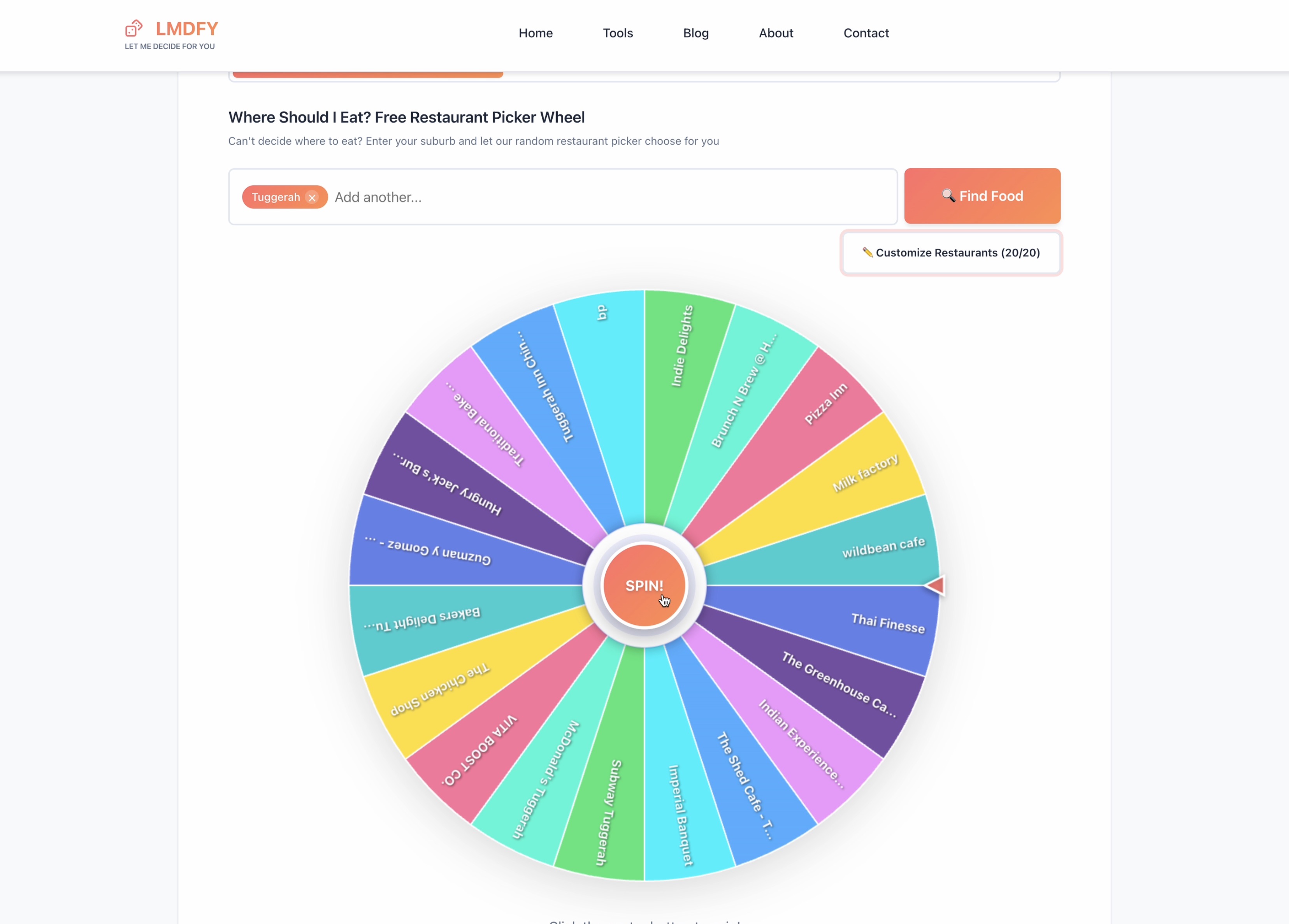
LMDFY: How a Spinning Wheel Solves the Lunch Decision Problem
Introduction: The Problem That Inspired a Project
Every office has the same lunch ritual. Someone asks, "Where should we eat?" Another person responds, "I don't mind, you pick." This leads to five more minutes of back-and-forth that somehow stretches longer than the actual lunch break. Fifteen minutes later, you're still at your desks debating whether to try that new place or stick with the usual sandwich.
This isn't just an office phenomenon. It's a well-documented cognitive challenge known as decision fatigue - the deteriorating quality of decisions that comes from making too many choices throughout the day. By lunchtime, most people have already made hundreds of micro-decisions, and their decision-making capacity is depleted.
Over the Christmas break, I decided to build something fun to solve this real problem: LMDFY (Let Me Decide For You) - a colorful spinning wheel that picks a restaurant for you with minimal effort.
The result? A decision wheel tool that turns a mundane office conversation into a few seconds of excitement, then a concrete decision. No more debate. No more decision paralysis. Just a spinning wheel, a confetti celebration, and a destination for lunch.
The Psychology Behind Decision Fatigue and Why This Matters
Before diving into the technical build, it's worth understanding why this problem is so significant.
The Paradox of Choice
Barry Schwartz's research demonstrates a counterintuitive truth: more options don't lead to better decisions or greater satisfaction. Instead, they create what he calls "the paradox of choice." When faced with too many options, people experience:
- Increased decision fatigue - Each choice depletes mental energy
- Reduced satisfaction - More options create regret about unchosen alternatives
- Decision paralysis - More choices make it harder to decide at all
- Diminished enjoyment - Even good choices feel less satisfying when other options existed
In the context of lunch, this means the more restaurant options available, the harder (and more agonising) the decision becomes. Ironically, suggesting 20 restaurants makes the group less satisfied than suggesting three.
How Spinning Wheels Bypass Decision Fatigue
A spinning wheel solves this psychologically by:
-
Removing personal responsibility - The wheel decides, not you. This creates psychological permission to accept the result without regret.
-
Creating entertainment value - The suspense of the spin and the celebration of the result releases dopamine, making the experience enjoyable.
-
Limiting effective options - Even with 20 restaurants on the wheel, people psychologically perceive fewer "real" options because they can't consciously choose.
-
Introducing an element of luck - People feel less buyer's remorse when luck (rather than their judgment) made the decision. This is called externalisation of responsibility.
-
Gamifying the process - The game mechanics (spinning, winning, confetti) tap into the same reward systems that make decision-making enjoyable.
This is why LMDFY works: it's not just a restaurant picker. It's a psychological tool that transforms a frustrating decision process into a moments of fun.
Design Philosophy: Building an Experience, Not a Feature
The real challenge with LMDFY wasn't technical - it was experiential. I wanted to create something that felt satisfying to use, that made the decision process enjoyable rather than stressful.
The Wheel Animation
One of the first things you notice about LMDFY is the wheel itself. When you spin it, you're not just clicking a button to get results. The wheel takes its time, building anticipation. It spins smoothly and feels responsive, neither too fast nor too slow.
I spent considerable time getting this feeling right. A wheel that jumps instantly to a result isn't satisfying. A wheel that drags on feels like it's wasting your time. The sweet spot is about 4 seconds of spin - long enough to build excitement, short enough to keep momentum. When the wheel slows down and comes to a stop, it feels like the result has weight and meaning, even though you know it's random.
The colors change and shift as the wheel spins, making each segment easy to distinguish. Each restaurant gets its own space on the wheel, clearly labeled with its name and rating. You can see what's available before you spin.
Finding Restaurants in Your Area
Instead of me curating a list of restaurants (which would be outdated in weeks), LMDFY uses real, live data from Google Places. When you type in your suburb, the app finds your location and searches for actual restaurants nearby. This means the wheel is always current. New places that just opened are there. Closed restaurants are removed. The ratings are real.
This integration happens quietly in the background. You just enter your location, and within a second or two, the wheel populates with nearby options. If you search the same area again, the results appear instantly because the app remembers your previous search. It's a small thing, but it makes the whole experience feel snappier and more responsive.
The Result Experience
When the wheel stops, a specific restaurant is selected. Rather than just showing you a name, LMDFY displays key information: Is it open right now? What's the rating? You get a direct link to Google Maps so you can see the exact location, current wait times, and directions. If you hate the result, you can spin again immediately. No judgment, no friction. Just spin until you get something you like.
Making It Work Everywhere
LMDFY needed to work on phones, tablets, and desktops without any lag or stutter. This meant being thoughtful about what gets loaded and when. The wheel animation stays smooth even on older phones. The search input responds immediately when you type. Results load quickly. I've tested it on a variety of devices to make sure the experience is consistent.
The app also works for people using keyboard navigation or screen readers. If you can't see the wheel, the results are still accessible to you through structured lists and descriptive labels. Accessibility isn't an afterthought - it's built into the core design.
What I've Learned Building LMDFY
Working on this project has taught me some important lessons about building decision tools.
The Paradox of Choice is Real
The psychology research on decision fatigue turned out to be spot-on. When I first started building LMDFY, I wondered if the novelty of a spinning wheel was enough. But after seeing how people interact with it, I realise the psychology is doing the heavy lifting. When you let the wheel decide, you feel differently about the outcome. You're not second-guessing your choice because you didn't really make it. That emotional distance from the decision is powerful.
Small Details Matter More Than I Expected
I spent an enormous amount of time on what might seem like small details: the exact duration of the spin, the way the colors fade, the font size of restaurant names on the wheel. These aren't "nice to haves." They're what make the experience feel right or feel off. A spin that's 0.5 seconds too long feels sluggish. A spin that's 0.5 seconds too short feels rushed. Getting it right is the difference between an app people want to use and one they tolerate.
Accessibility Isn't Optional
I built LMDFY with keyboard navigation and screen reader support from the start, not as an afterthought. This wasn't about compliance - it was about making sure everyone could use it. I've been testing with people who rely on screen readers and keyboard navigation, and their feedback has been invaluable. It forced me to think more clearly about my interface design.
Users Will Find Uses You Didn't Expect
I built LMDFY for office lunch groups, but I've already heard from people using it for dinner decisions with their family, for choosing which streaming service to pick a show from, for deciding where to take visitors when they're in town. This tells me the core concept of outsourcing low-stakes decisions to a fun tool resonates more broadly than I anticipated.
Building on Past Work
I've been exploring decision based apps for a while now.
Last year, I built Shelf Help, a book recommendation tool for discovering your next read. It was a smaller project, but it taught me something crucial: people genuinely enjoy outsourcing small decisions to a randomized tool, especially when the tool is well-designed and fun to use. Users didn't feel frustrated about losing control - they felt liberated from the paralysis of endless options.
I am also experimenting with other decision wheels like a Name Picker Wheel for generating creative names during brainstorming sessions, and a Random Team Generator for office activities. Each of these projects reinforced the same insight: decision wheels work because they remove friction from low-stakes choices and add entertainment value.
LMDFY is a natural evolution of this work. I wanted to take everything I'd learned about what makes a decision wheel effective and apply it to a real, practical problem that people face daily. Restaurant decisions felt like the perfect test case - everyone needs to eat, everyone faces this problem, and the stakes are low enough that randomization feels genuinely useful.
What This Could Become
Right now, LMDFY solves the restaurant problem. But the underlying model is bigger. Imagine using a decision wheel for:
- Shopping decisions: "What should I buy?" with product recommendations
- Travel planning: "Where should I go?" with destination ideas
- Entertainment: "What should I watch?" with streaming recommendations
- Reading: "What should I read?" bringing back the Shelf Help concept with better integration
The decision wheel format works beautifully across all these categories because the core insight remains true: people want to outsource low-stakes decisions to well-designed tools. As LMDFY grows, I want to expand into these areas while keeping the same design philosophy: simple, fun, useful, and respectful of the user's time.
I'm curious what categories people would find most useful. What decisions do you wish were easier?
Early Feedback and What I'm Hearing
Since launching LMDFY, I've been listening closely to how people are using it and what they're saying.
The most common reaction is delight at the simplicity. People appreciate that they don't need an account, don't need to download anything, can just visit the site and immediately start making decisions. The animations get mentioned frequently - people like that the wheel feels satisfying to interact with.
I'm also hearing from people who are using it in ways I didn't anticipate. Beyond office lunch groups, people are using LMDFY with their families for dinner decisions, for choosing where to grab coffee, even for deciding which streaming service to browse. This tells me there's something more universal here than just solving the lunch problem.
That said, I'm aware this is early days. I'm still learning how people actually use the tool and what features would make it more useful. What's working? What's missing? What would make you use it more often?
Known Limitations and Future Improvements
LMDFY is a real product with real limitations. I'm being honest about what's here and what isn't.
Right now, the search covers restaurants within about 2km of your location. If you're in a rural area with sparse options, you might get fewer results than a city search. Sometimes restaurant data is incomplete - a place might have opened recently but not yet show up in Google Places, or information might be slightly out of date. The search is currently limited to searching suburbs, this will soon be improved by allowing people to search by postcode.
I'd like to expand into other decision categories, but I want to do it thoughtfully. Each category has its own considerations and its own user needs. I'm not interested in just bolting on new wheels for the sake of it.
Accessibility is ongoing. I've tested with screen readers and keyboard navigation, but I know there's room for improvement. If you encounter accessibility issues or have suggestions, please let me know. User feedback helps me prioritize what to work on next.
What's missing from LMDFY for you? What would make it more useful?
Try LMDFY Yourself
If the lunch decision problem resonates with you, LMDFY is ready for you to try. Here's what to expect:
- Visit lmdfy.com - No signup needed, no download required
- Enter your location - A suburb name, postcode, or address where you want to eat
- Tap the Spin button - Watch the wheel spin and come to a stop
- See what's been selected - The winning restaurant appears with its rating, location, and a link to directions
- Decide what to do - You can go with the result, or spin again for another option
If you're making this decision with a group, you can send them the link so everyone sees the same wheel and the same result. One person hits spin, everyone gets a decision.
What would make this more useful to you?
Why This Matters
At its core, LMDFY is about something simple: reducing unnecessary friction in daily life. The lunch decision itself doesn't matter much. But the decision fatigue it creates is real. By outsourcing the choice to a thoughtfully-designed tool, you get your mental energy back for things that actually matter.
Most apps are designed to maximise engagement and keep you scrolling. LMDFY is intentionally the opposite. It's designed to be useful for a few minutes and then get out of your way. You come in with a problem (where should we eat?), you get a solution, and you move on with your day. That's it.
I'd Love to Hear From You
This is just the beginning. LMDFY works, people are using it, and the core concept is sound. But there's so much room to improve and expand.
I'm genuinely interested in feedback. Not just "this is great" or "this doesn't work," but specific thoughts:
- What works about LMDFY? What makes you want to use it?
- What's missing or frustrating?
- Are there other decisions you wish were easier?
- How would you use a decision wheel for something other than restaurants?
You can reach me on LinkedIn, or just email me directly. I read and respond to feedback.
What's Next
I'm planning to gather feedback from early users and use that to guide the next phase of development. The roadmap includes features like better cuisine filters, price range preferences, and the ability to save favorite restaurants. Beyond that, I'm exploring how the core concept could expand into other decision categories.
But I'm not going to guess what people want. I'm going to listen and build based on real user needs.
Thanks for reading. Now go visit LMDFY and let me know what you think. The wheel is ready for you.
Last updated: January 15, 2026
Have feedback? I'd love to hear from you. Reach out on LinkedIn.
Ready to try it? Visit https://lmdfy.com