
LMDFY - AI-Assisted Product Development Experiment
Personal B2C Project, Learning AI Tooling Through Real Product Development
Role
Product Lead & AI Collaboration Experimenter
Timeline
December 2025 - January 2026 (ongoing)
Collaboration
AI tools (Claude), independent development
Status
Live product with users
Why This Case Study?
This isn't a traditional case study showcasing client work. This is a deliberate experiment in understanding how AI tools can fit into real product development workflows. Rather than theorising about AI collaboration, I built a complete product from scratch using AI as a strategic partner throughout the entire process. The goal was to learn systematic AI collaboration skills while shipping something real.
Experiment Goals
- Learn AI collaboration workflows for product development
- Build systematic AI prompting skills and repeatable processes
- Test if AI could accelerate product development velocity
- Ship a real product solving a real problem (not just a learning exercise)
Problem & Hypothesis
As AI tools like Claude became more sophisticated, I wanted to understand how they could fit into real product development workflows. Rather than theorising about AI collaboration, I decided to run a practical experiment: build a complete B2C product from scratch using AI as a collaborative partner throughout the entire process, from market research through launch. The product itself addresses decision fatigue - the psychological phenomenon where making too many choices depletes mental energy. By lunch time, most people have made hundreds of micro-decisions, making even simple choices like "where should we eat?" unnecessarily difficult.
Hypothesis
AI tools could dramatically accelerate product development when used strategically - not as autopilot, but as a research assistant, strategic thinking partner, and implementation guide. The hypothesis was that with proper prompting and human judgment, AI could help compress weeks of research, planning, and decision-making into days, while maintaining quality and strategic thinking.
AI Collaboration Approach
Treat AI as a highly capable collaborator that excels at research, analysis, and generating options - but requires human judgment for strategy, prioritisation, and validation. Document everything extensively to understand what works and what doesn't.
Collaboration Workflow
- 1.Human sets direction and asks strategic questions
- 2.AI conducts research, analysis, generates options
- 3.Human evaluates outputs, provides feedback, makes decisions
- 4.AI expands on chosen direction with detailed plans
- 5.Human validates against reality and user needs
- 6.Iterate rapidly through this cycle
Development Phases
Phase 1: Market Research & Problem Validation
3 daysAI Role
Research assistant and competitive analyst
Human Role
- •Directed research questions and scope
- •Validated findings against personal observations
- •Identified which insights were actionable vs. interesting
- •Made strategic decision on product positioning
Activities
- •Competitive analysis of existing decision wheel tools
- •Market research on decision fatigue and psychology
- •SEO keyword research and search volume analysis
- •User behaviour patterns in similar tools
- •Opportunity gap identification
Key Outputs
- ✓Comprehensive competitive analysis of 12 tools
- ✓Market research report on decision-making psychology
- ✓SEO strategy with keyword targets and difficulty scores
- ✓Strategic positioning: "trustworthy + playful" differentiation
Phase 2: Product Strategy & Planning
4 daysAI Role
Strategic thinking partner and documentation generator
Human Role
- •Provided constraints (budget, timeline, skills)
- •Questioned assumptions in AI recommendations
- •Made final decisions on technical choices
- •Validated UX flows against real user mental models
- •Prioritised features based on MVP philosophy
Activities
- •Feature prioritisation and roadmap planning
- •Technical stack analysis and recommendations
- •UX flow mapping and user journey design
- •Content strategy and blog post planning
- •Monetisation strategy development
Key Outputs
- ✓500+ page planning documentation
- ✓Detailed implementation plan with daily tasks
- ✓Technical architecture decisions with rationale
- ✓Content calendar with SEO-optimised topics
- ✓Phased monetisation strategy
Phase 3: Design & Brand Development
2 daysAI Role
Design researcher and options generator
Human Role
- •Evaluated colour palettes against brand goals
- •Selected final palette (Electric Blue + Orange)
- •Made micro-decisions on tone and personality
- •Ensured accessibility wasn't compromised for aesthetics
Activities
- •Colour psychology research for decision-making apps
- •Brand personality development
- •Competitive design analysis
- •Accessibility considerations (WCAG compliance)
- •5 distinct colour palette options with scoring matrix
Key Outputs
- ✓Comprehensive colour trend analysis
- ✓Brand identity guidelines
- ✓5 colour palettes with implementation examples
- ✓Component design specifications
- ✓Accessibility compliance checklist
Phase 4: Implementation & Launch
2 weeks (ongoing)AI Role
Implementation guide and problem solver
Human Role
- •Wrote actual code (AI provided examples, not production code)
- •Made UX micro-decisions during implementation
- •Tested features with real users
- •Validated AI-generated content for accuracy and tone
- •Decided what to ship first vs. defer
Activities
- •Code architecture recommendations
- •Component implementation guidance
- •SEO technical implementation
- •Content writing for blog posts
- •Debugging and optimisation suggestions
Key Outputs
- ✓Live product at lmdfy.com
- ✓Multi-tool decision platform (restaurant wheel, yes/no, coin flip, etc.)
- ✓Blog with SEO-optimised content
- ✓Mobile-responsive, accessible experience
AI Collaboration Insights
What AI Excelled At
- Comprehensive research synthesis - AI could analyse competitive landscapes, psychology research, and market data far faster than manual research
- Generating strategic options - When asked "how should we position this product?", AI provided 5 well-reasoned options with tradeoffs
- Documentation depth - AI could create extensive, well-structured documentation that would take days to write manually
- SEO and keyword research - Understanding search volumes, difficulty scores, and content gap opportunities
- Exploring design alternatives - Rapidly generating colour palettes, layout options, and design rationales
Where Human Judgment Was Critical
- Strategic prioritisation - AI suggested many good ideas, but humans must decide what matters most given constraints
- Reality testing - AI recommendations needed validation against actual user behaviour and technical feasibility
- Taste and aesthetic decisions - Final design choices required human judgment on what "feels right"
- Scope management - AI tends toward comprehensive solutions; humans must ruthlessly cut to MVP
- Authenticity in content - AI-generated blog posts needed human editing to sound genuine and add personal insights
Unexpected Discoveries
- Quality of strategic thinking - AI could reason through complex tradeoffs and provide nuanced analysis, not just surface-level summaries
- Iteration speed - The ability to ask "what if we tried X instead?" and get detailed analysis in seconds changed the planning process
- Documentation as thinking tool - Creating comprehensive docs with AI forced clearer thinking about the product strategy
- Need for structured prompting - Vague questions got vague answers; specific, constrained prompts got actionable outputs
- AI as confidence builder - Having detailed research backing decisions reduced second-guessing and increased shipping velocity
AI Documentation Volume vs. Human Synthesis
One of the most striking aspects of AI collaboration is the sheer volume of documentation it can produce. While this depth is valuable, it requires significant human effort to synthesize, prioritise, and extract actionable insights. The screenshot below illustrates the extensive research and planning documentation generated throughout the project, demonstrating that AI accelerates research but human judgment remains essential for deciding what matters and how to proceed.
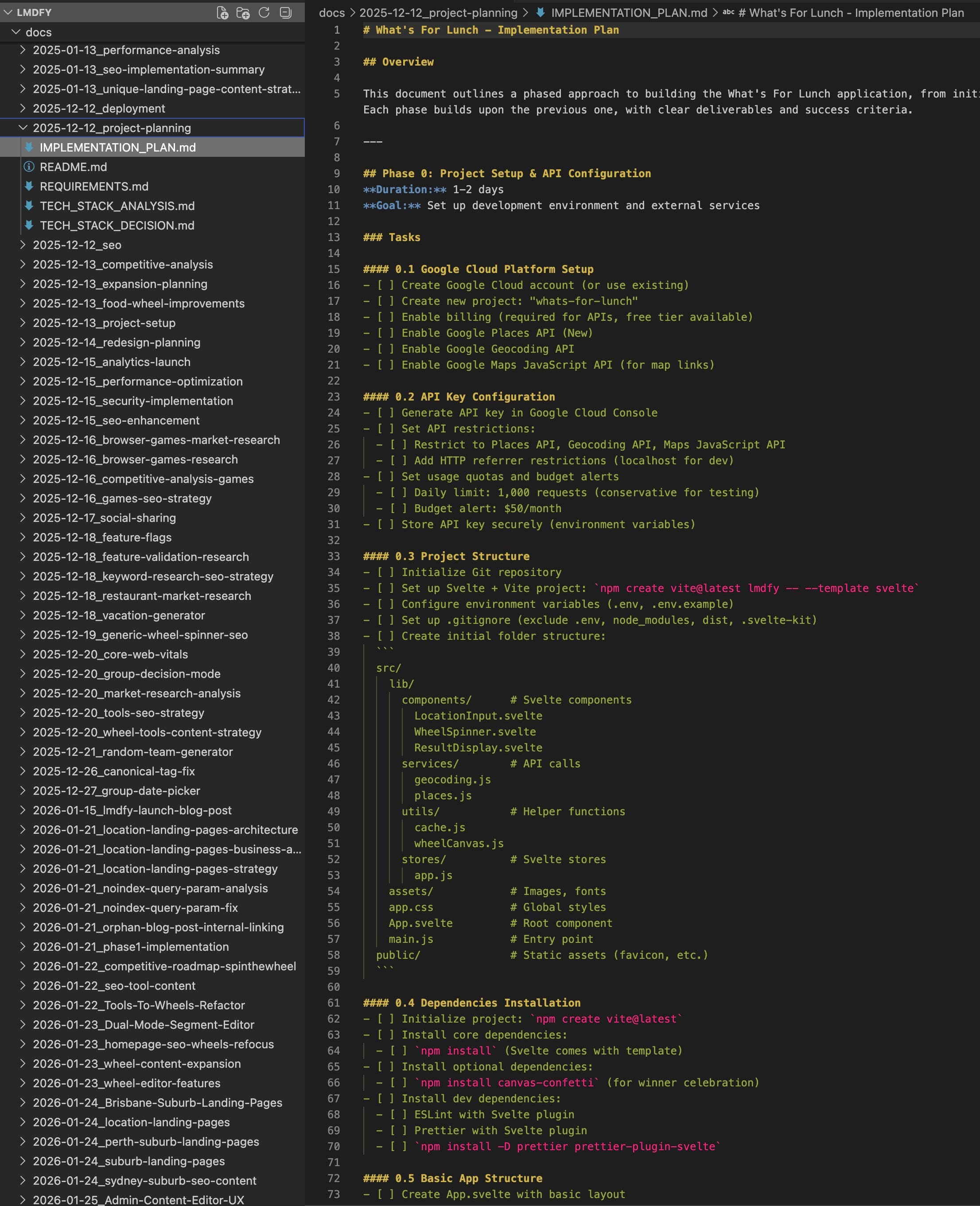
AI can generate comprehensive documentation quickly, but transforming 500+ pages of research into strategic decisions requires human critical thinking, context, and judgment.
Systematic AI Prompting Process
1. Frame the Question Clearly
Instead of "help me with SEO", ask "analyse the top 10 keywords for restaurant decision tools, including search volume, difficulty, and content gap opportunities"
Impact: Specific prompts yield actionable outputs, not generic advice
2. Provide Constraints and Context
Share budget limitations, timeline pressure, technical skills, and strategic goals upfront so AI recommendations are grounded in reality
Impact: Prevents wasted time on options that aren't feasible
3. Ask for Options, Not Solutions
Request "3-5 approaches to X with pros/cons" rather than "what should I do about X"
Impact: Maintains human decision-making authority while getting AI analysis
4. Validate with Reality
Test AI recommendations against actual user feedback, technical constraints, and competitive analysis
Impact: Catches AI hallucinations and overly optimistic assumptions
5. Iterate Rapidly
Use AI to explore "what if" scenarios quickly - try 5 positioning strategies in an hour instead of days of deliberation
Impact: Faster learning cycles and more confident decisions
6. Document Extensively
Capture all research, decisions, and rationales in markdown files for future reference
Impact: Creates institutional memory and enables better handoffs
Key Learnings
AI Accelerates Research, Not Replacement
The most valuable use of AI was compressing research timelines. What would have taken weeks of reading competitors, analysing psychology papers, and researching SEO keywords happened in days. However, the research still required human synthesis - deciding what was signal vs. noise, what applied to this specific product, and what to act on.
How I apply this now:
I now start every new product idea with AI-assisted research sprints. But I always validate findings with real users and competitive testing before making strategic commitments.
Documentation Quality Compounds
Creating comprehensive documentation with AI forced clearer thinking. When AI asked clarifying questions or suggested I define strategy first, it revealed gaps in my own thinking. The 500+ pages of docs weren't just outputs - they were thinking tools that made better decisions possible.
How I apply this now:
I now treat documentation as a first-class product development activity, not an afterthought. Well-documented decisions make future changes faster and reduce second-guessing.
Prompting Is a Skill Worth Developing
Early prompts were vague: "help me build a product". Later prompts were specific: "analyse these 5 competitor positioning strategies, score them on differentiation, market size, and defensibility, then recommend how LMDFY should position differently". Specific prompts got specific, actionable outputs.
How I apply this now:
I now spend time crafting prompts like I would craft user stories. Clear inputs create clear outputs. This skill transfers across all AI tools.
AI Suggestions Need Ruthless Pruning
AI tends toward comprehensive solutions. When asked about features, it suggested 20 good ideas. But shipping 20 features takes months. The human role is ruthless prioritisation - cutting good ideas to ship the essential core faster. AI can help analyse tradeoffs, but humans must make the hard cuts.
How I apply this now:
I now ask AI "if we could only ship 3 of these 10 features first, which 3 provide the most value?" Then I often cut 2 of those 3 anyway to ship faster.
Authenticity Requires Human Touch
AI-generated blog posts were well-structured and informative, but lacked personal voice and authentic insights from experience. The best content came from using AI for structure and research, then adding personal observations, specific examples, and honest reflections that only I could provide.
How I apply this now:
I now use AI for content outlines and research, but write all final copy myself. AI accelerates the process, but authenticity comes from human experience.
Velocity Changes Decision-Making
When you can explore 5 strategic options in an afternoon instead of 5 weeks, decision-making changes. You're less attached to your first idea because generating alternatives is cheap. This led to better decisions - not because AI made them, but because AI made exploring options faster.
How I apply this now:
I now default to "generate 3-5 options" for any significant decision. The speed of exploration has fundamentally changed how I approach product strategy.
Product Outcomes
Launched
January 2026
Platform
Web (mobile-responsive)
Key Features
- •Restaurant decision wheel with Google Places integration
- •Multiple decision tools (Yes/No, Coin Flip, Dice Roller, Number Generator, Name Picker)
- •Blog with SEO-optimised content on decision-making psychology
- •Accessible (WCAG AA compliant)
- •Fast (Lighthouse 90+ performance)
- •No account required, instant use
Early User Feedback
- ✓Users appreciate the simplicity and lack of friction (no signup, no download)
- ✓The wheel animation gets mentioned frequently as satisfying to use
- ✓People using it for unexpected purposes: family dinner decisions, choosing streaming services
- ✓Delight at the confetti celebration when the wheel stops
Live Product

LMDFY homepage featuring multiple wheel categories for different decision-making scenarios
What Worked
- Starting with research before building - AI helped compress research timeline from weeks to days
- Creating detailed documentation forced clearer strategic thinking
- Systematic prompting process improved output quality dramatically
- Using AI for options generation while keeping human decision authority
- Rapid iteration on positioning, features, and design alternatives
- Treating AI as a thinking partner, not a replacement for judgment
What Didn't
- Early vague prompts produced generic, unhelpful outputs
- AI-generated code often needed significant refactoring for production use
- Initial content drafts lacked authentic voice and personal insights
- Over-relying on AI suggestions without reality-testing against users
- AI's tendency toward comprehensive solutions sometimes obscured MVP thinking
Future Applications
- Use AI-assisted research sprints at the start of every new product idea
- Develop library of proven prompt patterns for different product development stages
- Create documentation templates that work well with AI collaboration
- Train team members on systematic AI prompting for research and analysis
- Build internal knowledge base of what AI excels at vs. where humans add most value
- Experiment with AI in user research synthesis and insight generation
Reflection
This experiment fundamentally changed how I approach product development. AI didn't replace strategic thinking or user empathy - it accelerated research, enabled rapid exploration of alternatives, and created space for deeper strategic work by handling synthesis and documentation. The biggest insight was that AI collaboration is a skill worth developing deliberately. Vague prompts get vague outputs; specific, well-constrained prompts get actionable results. The future of product development isn't "AI does everything" or "AI does nothing" - it's learning to collaborate effectively with AI tools to compress timelines while maintaining quality. LMDFY is live with real users solving a real problem. The product exists not despite using AI throughout, but in part because AI enabled faster iteration and more thorough research than would have been practical manually. The experiment succeeded: I shipped a complete product faster than traditional methods while learning systematic AI collaboration skills that transfer to future projects.
Try LMDFY
The product is live and solving real decision fatigue for users. No signup required, just visit and spin the wheel.
Visit lmdfy.com →Tools & Technologies
Note: This case study demonstrates a forward-thinking approach to product development in the AI era. The emphasis is on systematic AI collaboration workflows, learning transferable prompting skills, and understanding where AI accelerates work vs. where human judgment remains critical. The product itself serves as proof that AI-assisted development can ship real value to real users when approached thoughtfully.